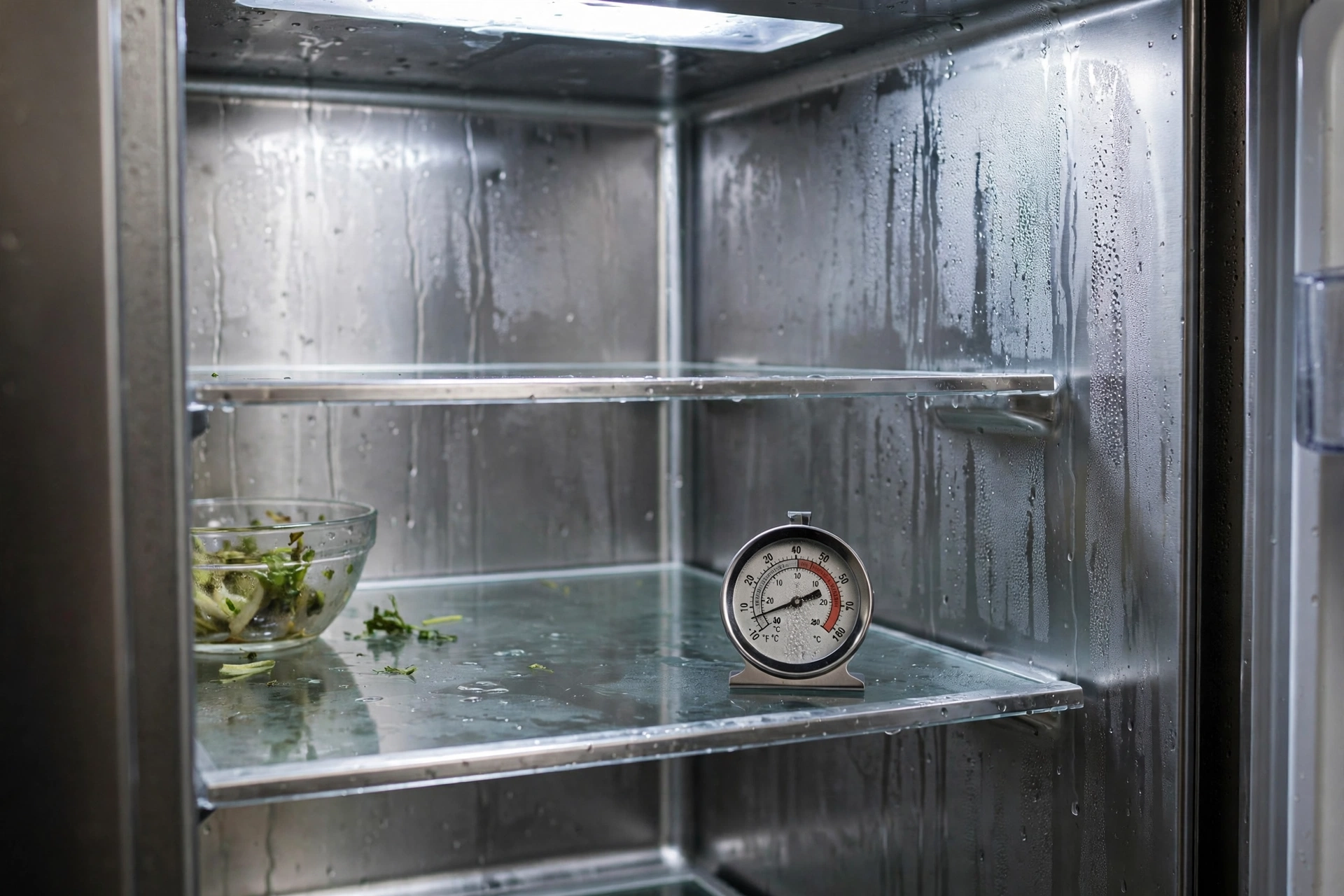
Freezer Cold, Fridge Warm — the Call We Get Most
"The freezer works, but the cooler is not working well enough." We hear that exact sentence — or some version of it — more than any other. Milk going off early, leftovers you don't trust, the fridge light on and the hum going but nothing actually cold.
Here's the thing: a refrigerator not cooling while the freezer stays frosty means the cooling system itself is working. Something between the freezer and your shelves is broken — airflow, a damper, a sensor, or the control board calling the shots. That's good news, because it narrows the hunt fast, and most of these fixes are straightforward.
And one honest flag: if the freezer side is softening too — ice cream going soupy, frozen food thawing — that's not this page's problem. That's a whole-unit problem, and the freezer repair side of the story explains what that looks like.
Six Reasons a Fridge Stops Cooling
1. The air damper is stuck shut.
Cold air is made in the freezer and ducted into the fridge through a damper. When that damper jams closed, the freezer stays frosty and the fridge section starves. Classic "freezer works, fridge doesn't" pattern.
2. Blocked vents inside the fridge.
Overpacking — especially tall items shoved against the back wall — blocks the vents that carry cold air down from the freezer. Sometimes the fix is rearranging groceries, not replacing parts.
3. A thermostat or temperature sensor lying to the board.
The thermistor reads 37°F when the shelf is actually 55°F, so the fridge never calls for cooling. The board is doing its job — it's acting on bad information.
4. A failing control board.
When the board itself goes, dampers don't open, fans don't run, and defrost cycles don't start. Boards fail from power surges and age, and the symptoms can look random — which is exactly why diagnosis matters more than guessing.
5. Condenser coils caked in dust.
The coils dump heat; when they're buried in dust and pet hair, the whole system runs hot and efficiency collapses. The fridge runs constantly and still can't get cold. (This one we can sometimes fix with a vacuum and twenty minutes.)
6. A refrigerant leak or dying compressor.
The serious end of the spectrum. A sealed-system leak means cooling capacity slowly bleeds away; a failing compressor clicks, overheats, or runs without actually pumping. These are the repairs where we'll talk honestly about whether the fridge is worth saving.
Don't Try These Fixes Yourself
- Don't crank the thermostat to max and hope. If the damper's stuck or the sensor's lying, a colder setting just overworks the compressor without fixing anything.
- Don't chip ice off the evaporator coils behind the freezer's back panel. The coils are thin aluminum — one slip punctures them and refrigerant escapes. That's a small repair turned into a big one.
- Don't ignore a compressor that's clicking on and off every few minutes. That's the overload protector tripping. Unplug the fridge and call — running it like that can burn out the compressor for good.
- Don't pull the fridge out and start unplugging wires to "reset" the control board. Boards are static-sensitive, and miswired plugs fry them.
- Don't keep the doors open while you troubleshoot. A fridge that's not cooling loses its remaining cold fast with the door swinging.
How We Trace the Cooling Path
We start with thermometers in both sections — real numbers, not vibes. Then we listen: is the compressor running, clicking, or silent? Is the evaporator fan pushing air? Next we check the damper — is it physically opening? Then the sensors: do their readings match the actual temperatures? We pull error codes off the control board if the model stores them.
If everything electrical checks out but cooling is still weak, we test the sealed system — pressures, temperatures across the coils — to catch a slow refrigerant leak or a compressor that's losing its pump. You get the finding, the price, and an honest opinion before we touch a wrench.
The Clock Is Running on Your Groceries. A fridge section that's not cooling is on a shorter leash than a dying freezer. Food-safety guidance says perishables held above 40°F for more than about 4 hours total should go in the trash — and unlike a full freezer, a warm fridge compartment has no ice mass buying you time.
Keep the doors closed, move milk, meat, and leftovers into a cooler with ice, and call (408) 539-4685 — same-day (subject to availability), because a warm fridge on Monday shouldn't still be warm Wednesday.
Brand Trouble Spots: Samsung and LG
Some brands fail in such specific ways that guessing is almost unnecessary:
- Samsung — if your Samsung refrigerator is not cooling, the ice maker is often part of the story (they freeze up and block airflow), along with Samsung's well-known sensor and control quirks.
- LG — LG refrigerator cooling problems skew toward compressor and fan-motor failures — including the infamous LG compressor issues that can take down cooling gradually.
Other brands — Whirlpool, GE, Frigidaire, Kenmore, Maytag — show up with the same damper/sensor/coil patterns described above. Whatever the badge, the diagnostic process is the same.
Your Repair in Three Steps
Step 1 — Describe the pattern. Tell us exactly what you're seeing: "fridge is warm, freezer is fine," "it beeps," "the back feels hot." The pattern points us at the cause before we arrive.
Step 2 — We test the cooling path. Thermostat to sensors to damper to fans to compressor — we check each link in order until we find the broken one, then quote the fix upfront.
Step 3 — You approve, we repair. One visit, one fixed price agreed before work starts. Most not-cooling calls end the same day.