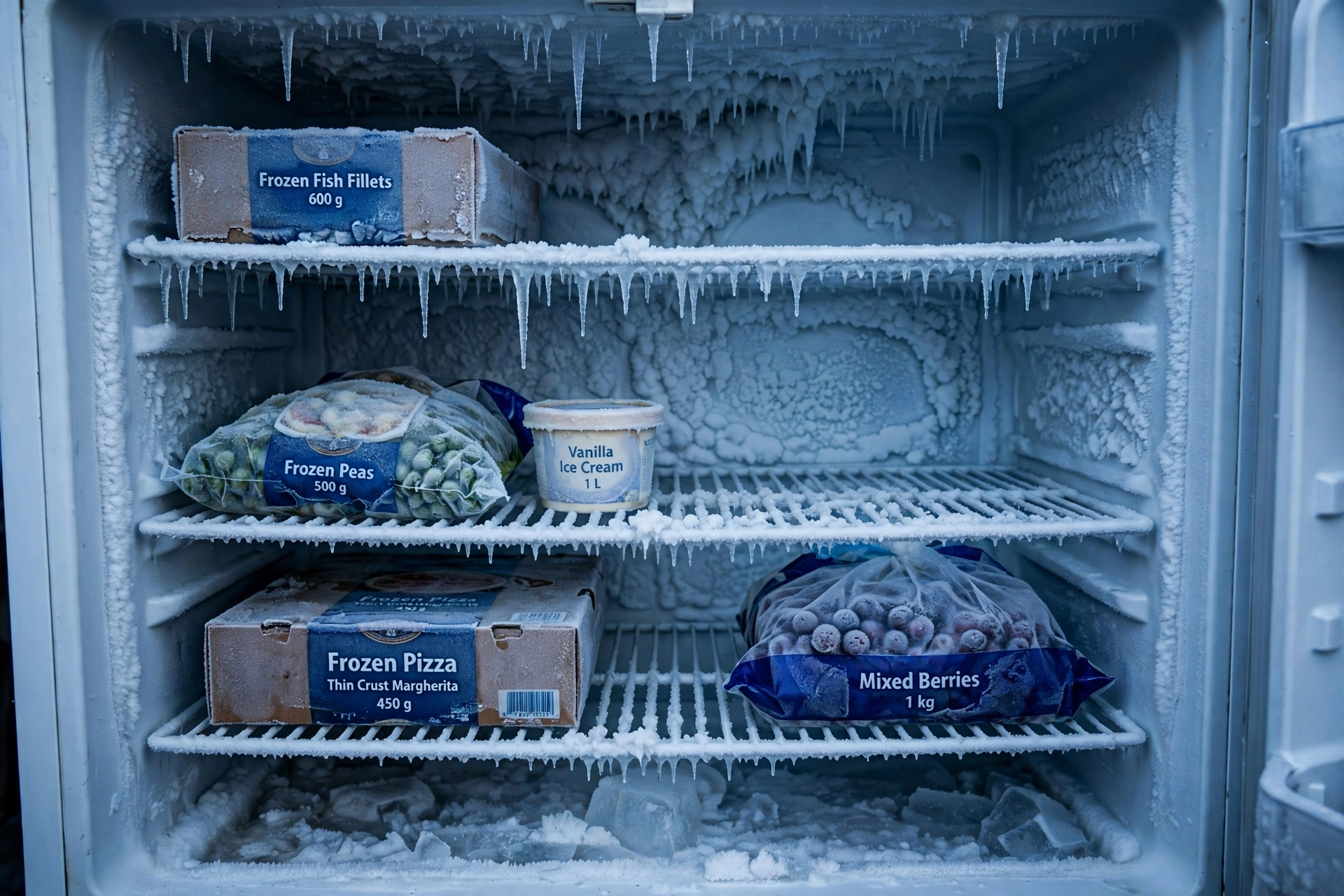
The Freezer Went Out — Now What
"The freezer went out on it." Short sentence, expensive problem: ice cream's soup, vegetables are soft, and there's a sinking feeling every time you open the door.
Freezer repair in Campbell almost always comes down to one system: the defrost cycle.
Freezer failures are their own animal. A warm fridge section means dampers and sensors; a dead freezer almost always means the defrost system — the heater, timer, or thermostat running the defrost cycle. Frost builds where it shouldn't, chokes the coils, and the freezer slowly gives up. It's a different failure with a different fix, and that's exactly what this page is about.
One honest check: is the fresh-food section warm too? If the fridge side is struggling alongside the freezer, that's a whole-unit problem — compressor or sealed system — and the refrigerator-not-cooling-in-Campbell breakdown covers that side. Freezer-only trouble? You're in the right place.
The Defrost System Is Usually the Culprit
1. The defrost heater burned out.
Every frost-free freezer melts its own frost on a schedule. When the heater dies, frost builds on the evaporator coils every cycle until airflow stops. The freezer looks fine outside while the coils turn into solid ice.
2. The defrost timer or control is stuck.
The timer tells the freezer when to pause cooling and run the heater. Stuck in cooling mode, defrost never happens — same result as a dead heater, different part. On newer models the control board runs this job.
3. The evaporator coil is buried in frost.
This is what the first two causes produce: a coil so iced over that no air passes through it. Compressor runs, fan spins, nothing gets cold.
4. The evaporator fan stopped.
A dead fan means cold air sits at the coils instead of circulating. Silence where there used to be a hum — or cold at the back, warm at the front — is the giveaway.
5. The door gasket is torn or not sealing.
Warm, humid air sneaks in around a bad seal and becomes frost — faster than defrost can melt it. Frost creeping around the door edges? Suspect the gasket first.
6. The thermostat stopped cycling properly.
Stuck "on," it runs the compressor nonstop and over-freezes; stuck "off," temperatures drift until the alarm sounds.
What Not to Do With a Dead Freezer
- Never chip ice off the freezer's back wall with a knife or screwdriver. The evaporator coils sit right behind that panel — puncture one and refrigerant escapes, turning a defrost repair into a sealed-system job.
- Don't unplug it for a day to "melt everything out" and call it fixed. That buys you a week or two — the failed part is still failed, so the frost comes back.
- Don't refreeze food that's fully thawed and warm. If it's still got ice crystals or feels refrigerator-cold, it can go back in once the freezer's fixed. If it's room-temperature and was perishable, it goes in the trash.
- Don't ignore a temperature alarm. The alarm means the freezer has been too warm for too long. Silencing it without fixing the cause just hides the problem.
- Don't keep opening the door to check on things. A full, unopened freezer holds its cold for roughly a day. Every opening spends that reserve.
The Tests That Find a Freezer Failure
We start at the back wall: is there frost, and how thick? A wall of ice on the evaporator cover screams defrost failure before we touch a meter. Then we test the heater for continuity — a dead one reads open, no ambiguity — and check whether the timer or board ever triggers the defrost cycle.
Next: does the evaporator fan spin freely? Does the gasket seal all the way around — the old dollar-bill test still works. We check the thermostat's cut-in and cut-out against real temperatures. Then you get the failed part and the price, before we start.
Your Frozen Food Has a Time Limit. A full, unopened freezer keeps food safe for roughly 24 hours; a half-full one, less. After that, anything fully thawed and warmed past refrigerator temperature needs to go — especially meat and seafood.
So the window on a freezer repair is real but not instant — which is exactly why same-day (subject to availability) matters here. Call (408) 539-4685, keep that door shut, and don't "wait and see" past today.
When It's More Than the Freezer
Freezer trouble rarely travels alone:
- Fridge section warm too? That's the whole-unit pattern — refrigerator not cooling in Campbell walks through the compressor and sealed-system side.
- Ice maker quit at the same time? A freezer that can't hold temperature starves the ice maker first. Ice maker repair covers the in-door side once the freezer's healthy.
- Water pooling underneath? Thawing frost overwhelms the defrost drain and ends up on the floor. If the puddle outlives the frost, our leaking refrigerator page covers the drain side.
- Popping or cracking sounds from the freezer? Some of that's normal expansion and contraction. New, loud, or constant popping isn't — noisy fridge diagnosis sorts normal from trouble.
Three Steps to a Freezing Freezer Again
Step 1 — Tell us the pattern. "Alarm going off," "ice wall on the back," "everything's thawing" — the pattern tells us which part to suspect before we arrive.
Step 2 — We run the defrost-system checks. Heater continuity, timer/board defrost output, fan, gasket, thermostat — tested in order until the failed part shows itself. Then you get the upfront price.
Step 3 — We defrost, repair, and re-freeze. We clear the frost properly (never with a knife), swap the failed part, and confirm the freezer's pulling temperature down before we leave.